This label identifies eligible RECs as compliant with CBET Frameworks between defined trade countries—signaling whether deliverability and other cross-border criteria have been met, and sufficient to denominate trade.
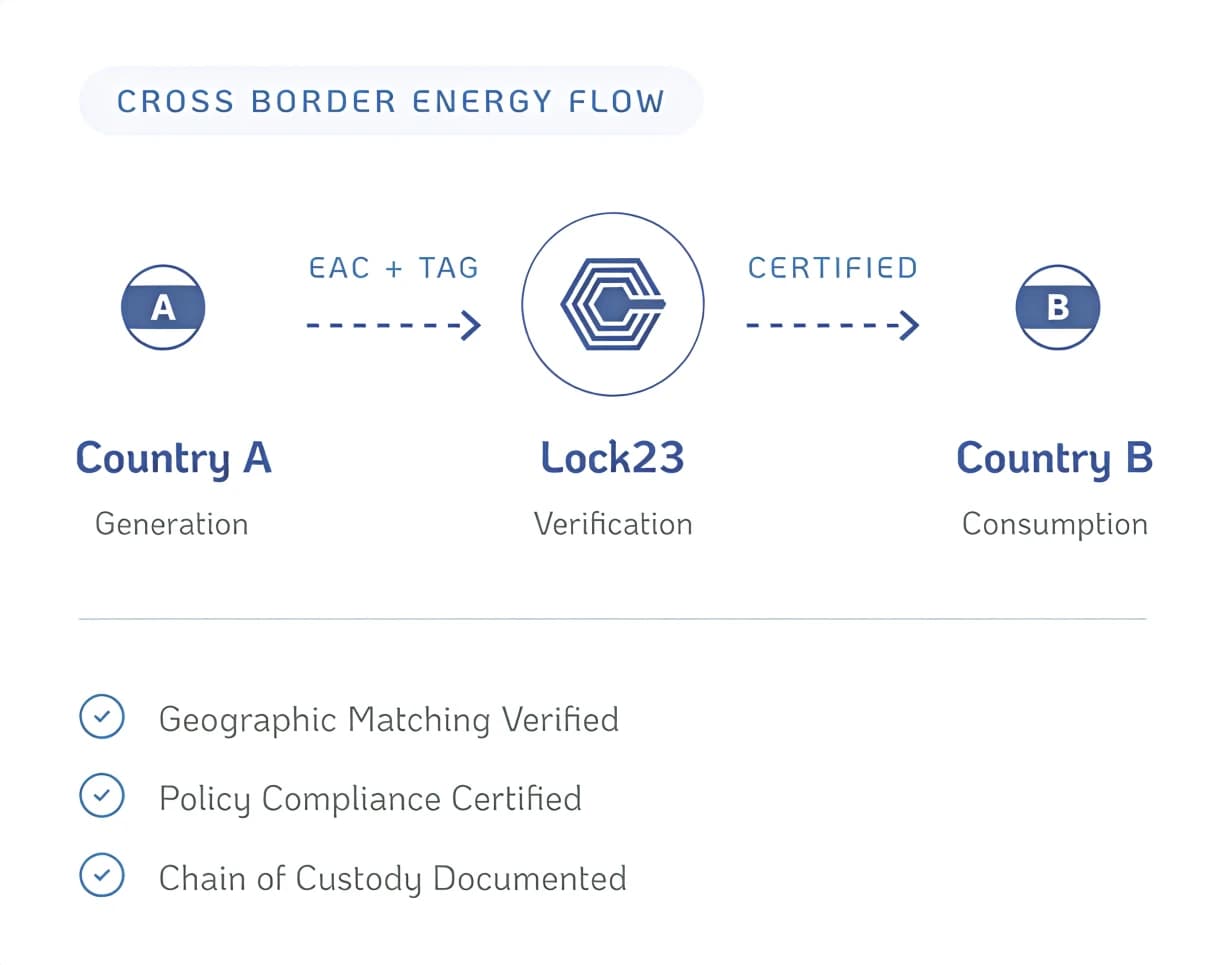
Multilateral power interconnections are expanding, enabling renewable electricity to move across national and market boundaries. However, REC alone does not contain the information needed to demonstrate that a cross-border transaction is physically deliverable, consistent with applicable national and international requirements, and suitable for corporate renewable electricity reporting.
Lock23's Cross-Border Label solves this by capturing and linking the transaction data needed to demonstrate physical deliverability, alignment with applicable credibility principles, and protection against double counting between the exporting and importing markets.
The result is a traceable chain of custody from the source country generating device to the consuming country's end-user.
Electrons should be physically deliverable from the export market to the import market. L23's CBET label captures evidence of electron deliverability, represented through either fungible or flow-based mechanisms, ensuring the volume claimed is equal to or less than the volume delivered.
The tracking systems used to denominate trade should be the same, or functionally interoperable, and recognised by both markets. L23's CBET label captures when, where, and how each national actor is calculating residual mix, and the extent to which they are harmonized with their neighbour.
National accounts for importing and exporting markets should harmonize to ensure that the renewable attributes are only counted once between countries. L23's CBET label captures proof that the same E/C system was used in both markets, and recognized by each jurisdiction for the purpose of cross-border trade.
Where additional information is required by end users, such as temporal matching, it can be linked to the label for CBET-eligible claims. This enables alignment with both the core CBET principles, and additional data features that may be required by reporting frameworks.
01
02
03
04
You generate renewable energy and export across borders. Lock23 certifies your output with device tags and labels that satisfy import country requirements.
You purchase cross-border renewable energy. Lock23 certifies that the energy meets geographic matching and national cross-border trade requirements.
You facilitate cross-border REC transactions. Lock23 labels provide the validation your buyers and sellers require for compliant trades.
Tag generation assets, pre-commissioned or at the registry level, with eligibility to issue CBET-labelled RECs, allowing market participants to discover, contract, and buy, CBET-eligible project outputs.
Confirm alignment with regulatory requirements in platform, for both source and destination countries, including EAC system recognition, and treatment of residual mix.
Compatible with I-REC(E). Labels work within existing registry infrastructure, allowing Participants to easily flag EACs as eligible in the registry.
Lock23 captures rules and national guidance to streamline reporting. Inputs from system users are minimized, while outputs clearly define levels of compliance between jurisdictions.
Clearly states which countries a REC can be delivered between; aligned with international standards and national guidance.
Complete documentation ready for regulatory submission, corporate disclosure, or third party verification. Secure access via unique URL.
Potentially. The Cross-border Label supports REC & Device labelling for any country-pair with established and aligned Cross-border REC frameworks. Contact us to learn if your country pair is supported.
To facilitate credible CBET trade between two markets, both countries must agree to align CBET principles for trade and publish an aligned CBET REC Framework. Contact L23 to discover how to begin this process today.
Device Tags identify a generation asset as capable of issuing cross-border RECs. Labels identify which specific RECs can be claimed as delivered between countries. Unlike Device Tags and Labels, Pre-Commissioning statements can be issued before the project is commissioned, to support project financing.
Potentially. The Cross-border Label is built in alignment with the I-TRACK International CBET Standard, and with national CBET REC frameworks established under country pairs. It is also directionally aligned with GHGP, RE100, 24/7 CFE and SBTi principles. For specific frameworks, we recommend consulting their documentation directly, for any additional criteria that may apply.
Whether you generate, trade, or consume cross-border renewable energy.
Lock23 captures the evidence to make your claims defensible.
